
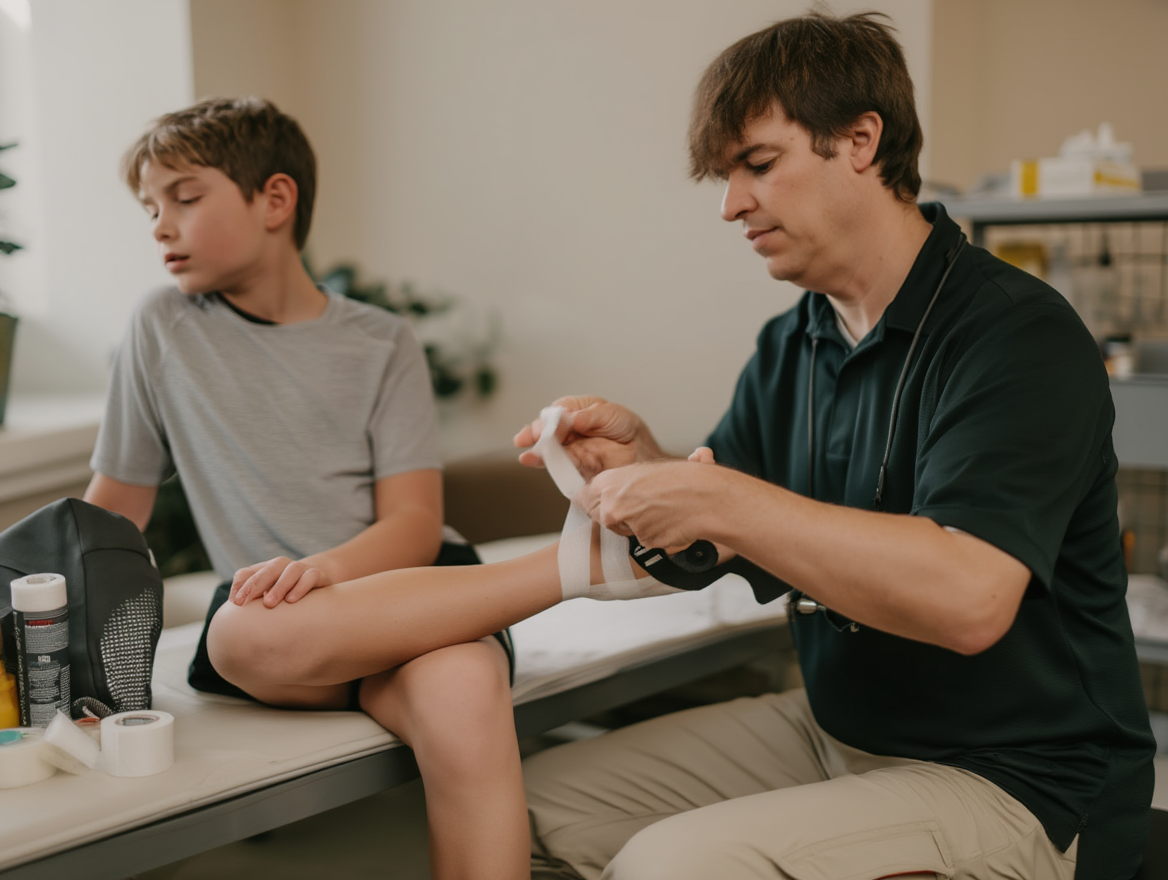
Many injuries in children and teenagers are related to overuse and don’t show up suddenly. These can be mitigated by carefully modulating training load, biomechanics, and recovery. But acute injuries can also occur in sport regardless of your best intentions and programming. Recognising injury severity – and the need for evaluation – early is paramount to recovery.
Tissue types in the body
During an acute injury, different tissue types are damaged for similar reasons – when a tissue is asked to do more than it is capable of, suddenly. Different tissue types have different names for their injuries:
- Muscles: strains, tears
- Tendons: tendinitis, tendon rupture/tear
- Ligaments: sprains, tears
- Bones: fractures (broken bones)
- Sometimes bones can break at the growth plates – the parts of the bone responsible for growing. These are called growth plate fractures.
Walk it off?
Most sports injuries can be evaluated by a child’s pediatrician, a sports medicine physician, or in an acute care setting such as urgent care or the emergency room. Not every injury requires a visit to a healthcare provider. However, any injury that meets one of the following criteria would likely benefit from an evaluation:
- Prevents normal function: unable to walk normally (limping), unable to use the hand or arm normally
- Not showing signs of improvement: the injury may not resolve completely in 3–5 days, but swelling, bruising, and pain should be decreasing in that window if a visit with a healthcare provider has not been considered
- Inadequate pain control: pain persisting through over-the-counter medications (acetaminophen/Tylenol, ibuprofen/Motrin/Advil)
No pain, no gain?
I’m not sure who should receive credit for this phrase, but it is pretty silly. Sport should be pain-free. Playing with a minor injury is a good way to progress it to a severe one. An athlete who pushes through pain is likely adding days onto the calendar for when the injury will be gone. A parent or coach who pushes a youth athlete through pain is doing the same thing – without the immediate feedback of pain that only the athlete can feel.
Injury prevention
Some injuries are not preventable. Acute injuries are more common and more severe in contact sports, and are more likely to happen to athletes who do not have a good biomechanical foundation. For example, an ankle sprain or fracture can happen to any athlete who rolls their ankle, but is more likely – and more likely to be severe – if another player forces that inversion with contact and additional force. Both scenarios are less likely to result in injury if the athlete has been working on ankle strengthening exercises beforehand. This framework applies to most injuries in sport.
R1 ReadyFirst’s movement screening tools are designed to help athletes identify deficiencies in their movement patterns and apply that risk analysis to their sport specifically. The injury prevention programming built into R1 is structured around exactly this kind of foundation work.
The takeaways
Acute injuries can happen to any athlete. Seek care if an athlete is having trouble functioning normally due to injury, if the injury is not showing signs of improvement after a few days, or if pain cannot be controlled with available over-the-counter medication. Acute injuries are more likely when higher forces are applied – in older athletes and contact sports – and risk can be meaningfully reduced with training that focuses on building the movement foundation that injury prevention depends on.
See how R1 approaches movement and the Body domain.
Injury prevention starts with movement quality. See how R1 ReadyFirst screens the seven fundamental patterns and builds from the baseline it finds.